I am starting by looking at some african photographers - African themselves and also photographers who photograph Africa.
I feel that this is a good place to start - and hopefully will lead me onto other photographers who will be closely linked with my projects.
The first photographer I am looking at is Malick Sidibé
Born in Africa in the 1930's, Sidibé worked on his family's farm until the age of 10 when he was sent to 'the white school'. He began drawing there, and gradually got better and better, until he He then got his first Brownie Camera and began working with photographer Gerard Guillat. Here he watched Guillat work and began to understand the art of photography.
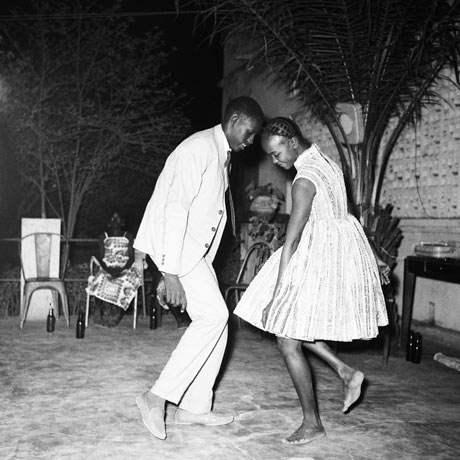 |
| ©Nuit de Noël, 1963 Malick Sidibé |
This image when I first looked at it along with many of Sidibé's other photographs, looks staged. But actually this image is not, they couple are dancing.
However, when he was photographing inside a studio, he did stage the images. He says "As a rule, when I was working in the studio, I did a lot of the positioning. As I have a background in drawing, I was able to set up certain positions in my portraits. I didn't want my subjects to look like mummies. I would give them positions that brought something alive in them" So perhaps the aesthetic of the images being staged, worked through in all of his images. So that even when they are not, they could be perceived as actually being set-up.
Sidibé had a small film camera, so he was often invited to dances because other photographers would have been using heavy wet plate cameras. This makes me wonder though... could they be completely unstaged? I mean, if he is using a film camera and it is low light... the exposure would be long. Or does he have a flash gun ?
The mans trousers in the image and the floor do look like they are reflecting light, so perhaps there is a flash, which would mean that they perhaps aren't staged. However, the photographer would not be un-noticed in this circumstance.
Sidibé works constantly with black and white film. Colour film fades in heat, so his photographs would not last as long as black and white would. He says he sticks to film because "It's what I know. And I can do my own developing and printing. A good photographer should always do that." (http://www.theguardian.com/artanddesign/2010/feb/27/malick-sidibe-mali-photographs-interview)
The Guardian says about this photograph, 'It's an astonishing photograph, full of intimacy and energy, joy and anticipation' Then goes on to say, 'Like all Sidibé's work, it captures the pride and exuberance of a generation of young Africans during two decades of momentous – and euphoric – social and cultural change.'
Personally, I don't like the kind of glare this photograph has from the flash. It kind of burns out part of the image and I personally wouldn't choose to produce images like this.
 | |||
| ©Family Party, 1966 |
I like how 'fun' this image is. Almost like it has been set up, people have been placed where they will be in the frame, but then left to 'mess about' until Sidibé feels it the right moment to capture. Or he took many photographs, and this is just the one he chose to print.
The images though capture African people having fun. There is no portrayal of 'the other' here because infact there is no 'other'. Photographer and subject are African.
