Wednesday, 11 December 2013

Sneaky Peak

These are a few examples of the images that I took whilst in The Gambia. I need to go through them all and edit down which can be used and which can't, then decide the outcome I want to produce and then begin working to make that happen.
©Sarah Neuenhaus

©Sarah Neuenhaus

©Sarah Neuenhaus

©Sarah Neuenhaus


Return from The Gambia

I returned this week from my trip to The Gambia. It was amazing !! I feel renewed and my energy levels are refreshed, and I feel excited to finish my degree and do these projects.

I took almost 800 images during my trip, most of these are for my university projects. I hoped to have many more images but it is so difficult, when you are around the children they want to hold your hand and give you hugs and they want your attention. So it is increasingly difficult to turn your back on that, or say no to holding a child's hand to take a photograph of them instead. I tried to do both, hold their hand to start with and stop let go and photograph them and the area around. However, this means you do lose some shooting time.

I think in order to be able to shoot the whole time, you need to separate yourself from any group or bond with the Gambian people. The whole reason I went there was to be with the families and children and give them hope, the university work happened on top of that, so thats where my compromise came in.

Saying that, I am very very excited to start working with the images I did take. I have had a quick look through them and I just feel so excited. This is good, because hopefully it means I will really push myself to do well, because I put so much effort into getting the images, I don't want to let myself or the children/people in the photographs down. I have a responsibility now to represent them and show them correctly through my work.

Daydream realization

Whilst doing a bit of daydream thinking about this work, it struck me that the art & craft work I collected from the children in The Gambia is from very young children, and whilst I was with them creating it, they were just so excited to be doing this sort of thing, they didn't care what it looked like. It was a true expression of their creativity and not their thought processing creativity. They just wanted to make a picture, not construct it through what their mind wanted to create. 
I think thats the approach i need to take with this work too. I need to stop thinking about it so much. Make a true representation of my journey in The Gambia and how it turns out will not be through me sitting for hours trying to make colour to colour and fit the text in perfectly. 

The Gambians, make their own clothes, jewellery, they cook outside on the sand path. They are not overly worried about how they look, are their clothes, jewellery and hair co-ordinated. 
So I am going to stitch into my work, use beads and shells and whatever things I can find around me. Just like they do !

Caroline Dyal

http://www.carolinedyal.com/About-Caroline-Dyal


I came across Dyal's 'Rio Collage Diary' which is exactly what it says. A diary made from collage of Rio.. it is a much simpler looking callage diary compared to Eldon's work, it has more of a scrapbook feeling I think.

But it does document a journey and it tells a story. A story told with mainly images and documentation rather than text.
I really like that you can tell it is handmade. It gives the viewer more of an attachment and interest in it .. if it was printed and digitally created I feel that it would lose a lot of what it has to offer.

Dan Eldon

http://www.daneldon.org/adventurer/the-journals/

Looking at Dan Eldons work i feel quite inspired. It looks like collage and it looks very personal to his journey. It is really cleverly a mix of text, image and drawing.

I think my work could be similar to this.. I have already made the images, am in the process of gathering text and whilst in The Gambia I collected some of the art and craft work that the children had created. So all of these things can be incorporated in a similar way to this work.


small ideas

I know that i want to create something with my hands…. I am thinking of a book/diary. I don't want to make it on a computer and send it to print.
The content of what I produce will include and maybe be about my experiences in The Gambia. Where they make everything by hand because computers, machinery etc etc is not readily available and the majority of the country is very poor so they can't afford to do anything but make and sell with their own hands.

So - I am going to research some diaries and see where it leads me

Monday, 9 December 2013

What to do..

My mixed media project has taken a bit of a back seat up until now as I have been getting my head around my dissertation and major practical project work.

I have just returned from my trip to The Gambia, and I have gained a lot of images, as well as some written pieces from the people I travelled with and a few craft things made by the children.
I want to create a book or a diary of some sort with all the things I have but I am really struggling to get my head around it.
It's hard enough when coming back from another country to reign yourself back in, but when deadlines are looming and you know you have so much to do, reigning your brain in it so difficult and I am severely struggling !

Wednesday, 20 November 2013

Can't make a decision

I am leaving for The Gambia in 6 days and I am struggling so much to get my head around this project. I keep going backwards and forwards over what I want to show through the film, and so cannot come to a firm decision on what I am actually going to film.

I am also going to be shooting images for my MPP work, and so am I going to push myself too much by trying to film at the same time? I'm worried that if I do this my work will be too weak to use for either project.

This is so difficult !

I have a feeling that my project idea will change whilst I am out there and then even more so when I return.
The idea of making a film is getting less and less inspiring to me.

Whilst out in The Gambia, I am going to shoot as much as I can and film what I can and then I will review my work and make a firm decision when I have returned.

I hate not being prepared, but this just seems the most sensible way to do it... otherwise I think I will ruin both projects.

Thursday, 14 November 2013

Photojournalism

Today I have been reading through this book - 
 and I have found a few photographers who's images stood out to me.

 Patrick Brown

Zomba, Malawi, 1994

I find this image quite problematic when analysing it against my work. Firstly, if this image where being used to try and get people motivated to donate time, money, aid to these people then it would succeed. It pulls at the heart strings in quite an obvious way.
However, in the actual print it is easier to see, the Doctors hands are white and the child is black. I feel that this really highlights 'the other'. If the purpose is to plea with white people then again it speaks volumes. 
It is a massive deal that so many people just glaze over and don't even realise when looking at photographs like this          .. a black child is dying or in need of major help
                                           .. a white doctor is giving the help


 David Burnett
Korem Camp, Ethiopia, November 1984

I personally really like this image.. it is a tender moment between what we presume to be a mother and child. The lady has a wedding ring on her finger, something that is not normally seen in photographs made to appeal for money. Having a ring, shows that she is not completely poor, even though the clothes are dirty and loose. 
I looked at this image and immediately thought 'the child is ill' 'the mother is leaving' 'they are praying' 'they are upset' 'life must be so hard'
However when time is taken.. and I started actually studying the image further I noticed things like the ring.

The caption next to this image reads 'Burnett uses his camera to demonstrate to the Wesern world the widespread famine and starvation throughout northeast Africa. He reflects: "Its still happening today, even though the West continues to generate more and more wealth.'

From this I think the image was created with the intention of pulling heart strings and trying to get Westerners to donate to these people out. Although, I can see myself creating an image similar to this, simply to document a tender moment between a mother and her child. Which shows that an image can easily be understood in many different ways, depending most probably on the background/mind set of the viewer. 

I will need to really take care in how my images are presented - to try and make sure the reason for the images is shown truthfully.


 Dan Chung
Tahoua, Niger, 2005


I personally love silhouette images in general, but I took a liking to this image because I feel it shows children at play. It shows that their lives are not just sitting, crying, suffering, posing for numerous photographs to make people feel sorry for them. 
This image really touches my heart.. but doesn't make me feel sorry for anybody. 
I personally would much rather look at a series of images of African children at play and feel like I should donate to keep things that way.. than look at dying children.

 Tim Hall
Dhewu's daughter, Tengenenge, Zimbabwe, 1994

This image is in colour, and quite bright colours. I think it shows the heat of Africa better. 

We are looking at a young child, looking at somebody else. When I first looked at this image, I felt that maybe she was looking at perhaps other children in play, whilst she washes up and does chores. Then my mind began to wonder, do the other children have parents doing their chores for them and she is orphan doing it by herself. Or perhaps, she is orphan doing her jobs, watching her younger siblings to make sure they are not leaving her sight.

There is again a lot that you can read from this image. Are we meant to feel sorry for her? What was the intention when this image was taken?

 Sebastiao Salgado
Mali, 1985

This image to me feels cold. It makes me feel so cold looking at it, especially the child with no clothes on. However, this image is taken in Mali in the drought, so actually it is so hot. The white vastness of the image though gives it a totally different feel.
Something to bear in mind when I am photographing.

 Ami Vitale
Female Circumcision, Guinea-Bissau

I find this image quite harrowing. The girls stare straight into camera, almost jumps out of the image and grabs you. The tears down her face, and the composition of the image make it such an emotional, captivating image. You almost feel compelled to stare back into her gaze, yet when you do so suddenly feel uncomfortable.
Her expression in some ways seems more like anger than anything. Like she is convicting the viewer of something bad. You feel bad for staring back at her, even though she cannot see you.

Dembel Jumpora, Guinea-Bissau

Again I like this image because it is more playful. From the same series as the above image, yet a completely different response from the viewer. There is no eye-contact, and it seems that none of the children have noticed the camera, so it is lighter viewing and you do not feel bad for being an on-looker. 


Wednesday, 6 November 2013

Susan Meiselas 'In History'

I found these pieces of text in Susan Meiselas 'In History' p14, an interview by Kristen Lubben.

This piece I think links to my Mixed Media ideas. I am going to ask the other British people that I'm travelling with to a write down a memory of each day, at the end of each day. I also am going to try to collect some drawings or written pieces from the African children to merge together and use within my Mixed Media work.

Meiselas did this with some of her work. She took her contact prints back to the subjects within them and asked them to write about the image, she then used the text and image together.


This second piece, I felt just really spoke to me as a practitioner. I am also really interested in knowing whats behind an image. I don't enjoy photographing people on the street, because I don't want to portray them wrongly.
This also links to my MPP work, because I am hoping to know a bit of background of the people I photograph in Gambia. My work is not going to portray people wrongly, hopefully, so I really felt that this spoke into my practice as well.


Visual Bibliography

Here is a visual bibliography of the books and film that are first on my reading list. Hopefully these will lead me onto new books, websites, journals and films.


Dissertation Tutorial 1

This week, I had a tutorial about my dissertation. I had a rough idea of what I wanted to write about and research but felt it was too broad and needed to be narrowed down, however I was really struggling to do this process on my own. It really proved that sometimes getting an idea out of your head and either onto paper, or hearing it come out of your mouth can really help you to make sense of things.


These are the notes that I made during that meeting. So I will be looking at photographers; Don McCullin, James Nachtwey, Kevin Carter, Susan Meiselas. As well as watching things such as Live Aid and Children in Need.

I am going to be researching photographic truths, documentary truths and in particular the representation of African Children.

This will link perfectly with my Major Practical Project and hopefully with my Mixed Media project however I still need to have a tutorial about the outcome of that module. But I am beginning to feel a little more excited about all of my work, and hopefully each one will strengthen the others. 

Laura Pannack

http://laurapannack.com

©Laura Pannack
Both of these images are taken from Pannack's commissioned series 'Don Bosco'.  They both are documentary photographs, but at the same time they could easily be staged photographs. Seeing these images is what led me to contact Pannack, and find out.

©Laura Pannack 
I feel that the images may be similar to the images I could return with from The Gambia, and I really wanted to find out how she has achieved them, so that perhaps I could have the same way of working, or draw on her techniques for inspiration whilst out there.

©Laura Pannack
These two images (above and below) are from the series 'Saving the Cursed Children of Ghana'. They really stand out to me because in both images life is being documented, although there is 1 or 2 people (children) who have noticed the camera. Is is the camera that they have noticed, or is it the photographer? The photographer we know is a British female, so is that what attracts the attention of the children. Are we seeing the idea of 'the other', shown both through the image taken, as well as the content in the image. We are looking at 'the other' in the photograph, but they are looking at 'the other' taking the photograph.

This is a really interesting point me for to be stuck on. In my work, I don't want to necessarily show that bridge between 'the other', I don't want to make that statement. But, how do I avoid it? Did Pannack intend for this to happen ?
Also, why is it the children who notice rather than the adults? Would the (parent? is it a parent?) adult not be protecting the child from onlookers, are they so poor that they do not care, or is their work just too important to them that they are so in grossed they do not notice?

Did Pannack position these children like this, looking at the camera? Did she direct the image and only instruct those 1 or 2 children to look to camera?

From the email response I had from her, I don't feel that the image is that staged. I wonder if perhaps she had spoken to or interacted in some way with the people looking to camera, maybe she asked if she could take their photograph but didn't specifically pose them in the way that they are seen.


© Laura Pannack


Laura Pannack - making contact

I spent some time after Laura came and spoke to our class at university, looking at the aesthetics of her wok. Especially her work 'saving the cursed children of Ghana', 'home' and 'Don Bosco'. I really started to notice that her work is a mix of posed images and documentary photographs. I felt like because it is similar to what I hope to do in The Gambia, I should ask her how she achieved the different photographs and the things she maybe struggled with.
So I sent her an email. Her response included this:

"Translation will be imperative

I directed people as well as documented. I dont really have a rule when taking images . you will do fab as half the fun is not knowing how you are going to take your picture until you arrive. Keep your eyes opn, look for things that define your subjects life and character and don't rush"

So.. for me going out to The Gambia I feel that her response was exactly what I needed. 
I am not going out with a plan of what my images are going to look like exactly, so  half the fun is not knowing how you are going to take your picture until you arrive speaks directly into my project right now. I am excited and scared at the same time as to how these images are going to turn out. But as Laura says.. don't rush! I need to take my time, really think about composition. I don't to come back with thousands of snap shots, I want to take considered meaningful images that I will successfully be able to use for university work and exhibition. 

I want to represent the subjects and people in my images well, I do not want to portray them in a way that is not true to them. So I really need to take my time, be aware of surroundings and get to know the people that I am photographing before subjecting my own opinions and views onto them within the photograph. 


Wednesday, 30 October 2013

My work

Thinking about my film that I hope to produce, I am struggling to plan what I might show through the film.
It is difficult because I am travelling to a place where I really am not sure what to expect when I get there, I am unsure of what I will be doing whilst there and because I am going as part of a group I cannot pre-plan my trip. If I were going alone or with family then I could do extensive research into Gambia and decide what I would like to show and then travel out to that place to gather footage. But I have to go where the group goes on this trip (it is not safe to travel alone in The Gambia - especially as a young white female).

It is going to be really challenging and I will have to think quick whilst I am out there to make enough footage, and footage that I can use.
I think before I go I will have decided whether I will be filming the people, the surroundings, the animals, children, school or villages etc etc.

Wednesday, 23 October 2013

David Goldblatt

Whilst looking at the work of Samuel Fosso, I came across David Goldblatt. He is a south african photographer working in Johannesburg.


"Goldblatt focuses on critical explorations of South African society. While he uses photography as a means of accessing and exploring people and societies, David Goldblatt is acutely aware of the ethics of photography, and has used the camera as a way of capturing the complexities and intricacies of the specific conditions and situations that he photographs. His photographs are neither propaganda nor violently provocative, but rather become far more complex, meditative documents that are open to interpretation and that permeate far more deeply, and for longer than the initial shock and violence associated with documentary and news photography." (http://www.goodman-gallery.com/artists/davidgoldblatt)

I particulary am drawn to the exhibitions titled 'Some things old, some things new and some much the same' and 'Fietas'


©Zulu woman salvaging bricks for a white contractor from Indians' houses demolished under the Group Areas Act, Fietas, 1982
© Hassimia Sahib's


©The Methodist Church (natives), City and Suburban, August 1961 (3_3216), 1961

©27 April 2007 (4_A0508), 2007


I feel that these images are what I may have gained after my trip to The Gambia. They are documenting an area, a time and a people. They are not staged, and I don't feel that they are biased.
I think there may be a sense of 'the other' coming through, but not in a way that makes them less than the photographer. He keeps their dignity intact. As the statement above says, he is aware of the ethics of his photographs, he knows that he could offend somebody very easily if he photographs them in a demeaning way. But he doesn't do this. It is obvious I feel that he is documenting that time, making record of it rather than exploiting it.

Samuel Fosso

Samuel Fosso started his career as a photographer at a young age of 13 ! YES 13!!

He opened his own studio, where he would take photographs of people for passports, portraits and weddings. It was called Studio Photo Nationale, and his motto was: "You will be beautiful, elegant, delicate, and easy to recognise." (http://www.theguardian.com/artanddesign/2011/jun/19/photographer-samuel-fosso-best-shot)

His clients generally wanted their photographs the next day. So if the roll of film wasn't finished Fosso would take self-portraits, to prevent any waste of film. Originally they were to send to his mother, so that she knew he was okay. He then began experimenting more with the self-portraiture; using new poses, costumes, new techniques.

Fosso uses a Hasselblad and an auto-timer. His photos are highly posed and staged, yet he makes statements.

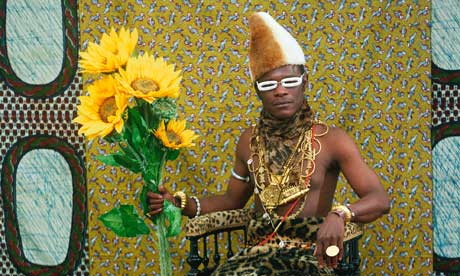
Samuel Fosso's self-portrait as an African chief
© Samuel Fosso's self-portrait as an African chief.

"I am an African chief, in a western chair with a leopard-skin cover, and a bouquet of sunflowers. I am all the African chiefs who have sold their continent to the white men. I am saying: we had our own systems, our own rulers, before you came. It's about the history of the white man and the black man in Africa. Because they may try to cover it up these days, you know, but underneath it's still the same."

 I like that Fosso is making a statement through his work, it is as though he is trying to bring forward issues without making a biased statement, he is bringing it forward and allowing others to think and make up their own minds. It is really quite powerful.

In my work however, I won't be doing self-portraits and I'm hoping to not set-up any of my images. Yet just document what I see and experience. I don't feel that this work has any direct influences into my work, at this present time.


Malick Sidibé


I am starting by looking at some african photographers - African themselves and also photographers who photograph Africa.
I feel that this is a good place to start - and hopefully will lead me onto other photographers who will be closely linked with my projects.

The first photographer I am looking at is Malick Sidibé

Born in Africa in the 1930's, Sidibé worked on his family's farm until the age of 10 when he was sent to 'the white school'.  He began drawing there, and gradually got better and better, until he  He then got his first Brownie Camera and began working with photographer Gerard Guillat. Here he watched Guillat work and began to understand the art of photography. 


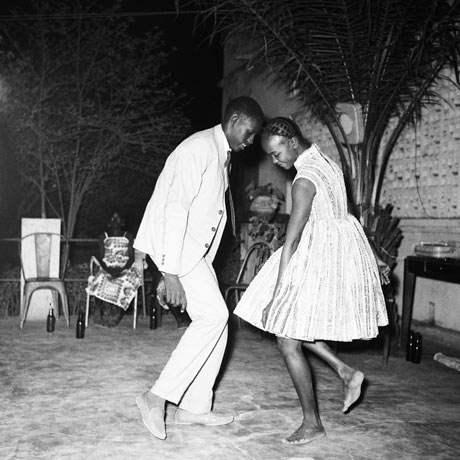
Malick Sidibé: Nuit de Noël, 1963
©Nuit de Noël, 1963 Malick Sidibé

This image when I first looked at it along with many of Sidibé's other photographs, looks staged. But actually this image is not, they couple are dancing.  
However, when he was photographing inside a studio, he did stage the images. He says "As a rule, when I was working in the studio, I did a lot of the positioning. As I have a background in drawing, I was able to set up certain positions in my portraits. I didn't want my subjects to look like mummies. I would give them positions that brought something alive in them" So perhaps the aesthetic of the images being staged, worked through in all of his images. So that even when they are not, they could be perceived as actually being set-up.

Sidibé had a small film camera, so he was often invited to dances because other photographers would have been using heavy wet plate cameras. This makes me wonder though... could they be completely unstaged? I mean, if he is using a film camera and it is low light... the exposure would be long. Or does he have a flash gun ?
The mans trousers in the image and the floor do look like they are reflecting light, so perhaps there is a flash, which would mean that they perhaps aren't staged. However, the photographer would not be un-noticed in this circumstance.


Sidibé works constantly with black and white film. Colour film fades in heat, so his photographs would not last as long as black and white would. He says he sticks to film because "It's what I know. And I can do my own developing and printing. A good photographer should always do that." (http://www.theguardian.com/artanddesign/2010/feb/27/malick-sidibe-mali-photographs-interview)

The Guardian says about this photograph, 'It's an ­astonishing ­photograph, full of intimacy and ­energy, joy and anticipation' Then goes on to say, 'Like all Sidibé's work, it captures the pride and exuberance of a generation of young ­Africans during two decades of momentous – and euphoric – social and cultural change.'

Personally, I don't like the kind of glare this photograph has from the flash. It kind of burns out part of the image and I personally wouldn't choose to produce images like this.

 - next picture 
©Family Party, 1966
In this image though, the flash isn't so overwhelming. I think you hardly notice that there has been any flash used. The reason I think flash has been used here is that the lady on the left of the image, in the white top, the top is very bright and blown out.

I like how 'fun' this image is. Almost like it has been set up, people have been placed where they will be in the frame, but then left to 'mess about' until Sidibé feels it the right moment to capture. Or he took many photographs, and this is just the one he chose to print.

The images though capture African people having fun. There is no portrayal of 'the other' here because infact there is no 'other'. Photographer and subject are African.

Wednesday, 16 October 2013

Floating ideas

During a lecture on Photography and Anthropology my brain started ticking and ideas started flowing and my page turned into a mess of scribbles where I was trying hard to note take for the lecture as well as get my ideas out of my head and onto paper.

We were thinking about the idea of 'the other'. 'The other' defines someone other than one's self, they are identified as 'different'.
Anthropology is basically the study of a group of people - rather similar to sociology but with more depth I think.
I have always been interested in people, and regularly can be found sitting in a public place 'people watching', I just get so fascinated in other people and how our paths can cross yet we know nothing about them.

The issue then of needing to know historical and contextual backgrounds of people before trying to represent them is really important.  This is major, because when making 'judgements' over people it can be very offensive if you have not taken the time to get some knowledge of them before hand. Stereotypical statements aren't helpful or useful when you are studying in depth a certain type of behaviour or group of people.

My thoughts constantly on my trip to The Gambia, I began thinking about how my photographs may represent people, and whether I will do this offensively or not. Because I am only going to be in The Gambia for 10 days, I don't have the time to get to know individual villages backgrounds or the family backgrounds of the children before photographing them, and soon realised this could be a problem. I would hate to photograph a child, not be able to get a parents permission (because of the circumstances of the trip and only visiting the school and local village) and then use the image in exhibition or elsewhere and cause problems in someway. I do not want to do that. So I began to think, how can I still take photographs, and document my trip but anonymously to them and perhaps also myself.
MY FEET !
I have a great disliking of my feet - so not many people have seen them or will ever see them. However, as much as I dislike my feet, they are what get me to the places I want to get to. They are what are going to get me around The Gambia. So.. how about if I document my feet and the places they go for the 10 days that I am in Africa?

With this idea floating around and needing to be brought into reality of am idea.. needing to be refined I went to talk to a tutor about it.

This is the outcome of the meeting:

* my feet would give away too much to the viewer.
     - It will be hot over there so chances are I will have skin showing, therefore the viewer will be able to see that I have white skin.
    - My choice of footwear or sandal would most probably tell the viewer that I am a female.
   - This could put another message into the photographs.. maybe it would make it seem that I am making known 'the other' which actually is not what I am wanting to achieve.
My trip is with a Christian organisation so the trip is about equality and everyone being equal, and we are going to try and help the poorer families and show love. So the idea of showing 'the other' in another way would not be what I would want for my images.

*I am to consider documenting:
   - the school
   - the children in the school
   - the other volunteers I am travelling with
   - Gambian culture - football
                                 - socialising
                                 - shop fronts
       
Basically, I am to document EVERYTHING.
I am only out there for 10 days so this is going to be a massive challenge, but if I am prepared before I go and if I photograph pretty much everything whilst I am out there then I will be okay.

*I need to think now about what the aesthetic of my final work will be so that while i'm out there and shooting I can have that in my mind and therefore, keep things consistent.


Inspired

In our first lecture we were shown some examples of things we could create for our mixed media practical assignment. These were things including; interviews, series' of experimentation, sculpture, participant based research, film, books, animation, graphic design, installations, archives, sound recordings, etc.

One of the things that really struck me was
'Days Like This - Washing of Hands' by Joel Simon (2008)

As I am soon to embark on my own journey to The Gambia, Africa, it struck me as something I may be able to create. Also, I have been to The Gambia before, so it struck me because I could relate to the things the film talks about. It is a woman's voice we hear, which again helps me to connect to it, being a woman myself and she has a very soft, gentle voice that is really easy I feel to listen to and almost to sympathise with. Even though I don't think the point of the film is to gain sympathy.

Watching the film, it seems that the creator has really spent a lot of time with the person whose story is being told, the visual artwork fits so well with the audible sound. It is not a case, it seems, of a story being submitted and a voice being recorded and then a film being thrown together around the sound, it all totally and complete engages with each other. The words emphasise what is being seen, and the visual emphasises what is being heard. The time that went into this must have been great.

It is really difficult to express the way that this film makes me feel. It is uplifting at the same time as being sad, it makes you think, it captures your gaze, your thoughts and your .. complete attention.

It has really inspired me .. Hopefully after a little more research I will be able to pick out what exactly it is that drew me in and captured me and then create something of my own.

Tuesday, 15 October 2013

Stop Procrastinating and Get on with it

Here goes my first blog post of the year...

I have been sat staring at the computer screen for a while now, unsure of how to start. I suppose sort of scared to start because it means third year has officially started, time is going to whizz past at lightning speeds and I feel like I want to cry. However, it has to happen at some point and why keep procrastinating? Lets just do it!!

This first week of term has been exciting, yet at the same time scary and daunting. I have 3 modules to pass this year, these being: Dissertation, Mixed Media and Major Practical Project. The advice given is to merge the 3 together in some way, make threads stronger and stop my brain become a massive tangled mess of stress and excitement.

As many people are aware I am travelling to The Gambia in November of this year and so I have been wanting to merge that into this years work. If I didn't then I would be very mixed up and stressed and not very dedicated to my work. However, by combining the two things together I hope it will help me out and allow me to be more organized.

So... my first ideas are:

Dissertation - Looking at photographers who have photographed in difficult areas. For example, war photographers, photo journalists, photographers who have photographed in Africa. This needs refining and needs a lot of work put into it but is my starting out idea.

Mixed Media - We were shown a film in lecture 'Days like this - Washing of hands' by Joel Simon. It spoke volumes to me ! (I will do a separate post about why it spoke to me later on as initial research) So I think I would like to do something similar to this for my work. A video, kept anonymous, about the things that strike you when in a foreign place. This may include sound pieces, illustration, text, spoken word, etc etc.

Major Practical Project - I had the idea of documenting my journey to The Gambia, in an anonymous way by photographing the journey my feet take. I really don't like my feet at all, but in a weird way they are one of the most important things to me because they get me to the places I want to go and allow me to see things by taking me there. I like the idea of representing someone or something, without actually showing them/it. This would be a challenge, but as a first idea it has really got me excited and I want to do it now. That has to mean something right? If I want to just run and jump and shout and do research into it then it must mean I have truly clicked with the idea!

So.. now to have a tutorial with lecturers and do some research and see what happens!